

How to transform vegetable waste
And why your dinner won't taste as good without it

Welcome back to Fallow Chefs, lifting the lid on restaurant cooking for you at home.
This week we’ll be looking at a subject that sounds dry and administrative, but secretly holds the capacity for the kitchen’s greatest creativity: vegetable waste. We’ll discuss our own journey with it, why understanding it makes your food taste better, and a killer recipe to get your juices flowing.
Before we get there, a quick reminder that we’ll be sharing a recipe every week, along with lots of other extras on our Substack page including our subscribers only chat forum, Q&As, and behind the scenes deep dives. Subscribe to join us and get in on it all.
Let’s get started.
Jack & Will
To say that Will, myself or Fallow as an entity have invented low waste cooking would be laughable. It’s something that cooks have been doing intuitively for years and years, and which many chefs before us have popularised.
The first time the concept was really broadcast to me was through St John’s. The restaurant opened in ’94 and a few years later (when I was just 7) Fergus Henderson published Nose to Tail Eating: A kind of British cooking. As far as I’m aware Henderson actually coined the phrase and it’s been one of those defining phrases within the industry which has had a life of its own.
For me, the concept of using what you have was intrinsic in my relationship with food. I’ve been cooking for as long as I can remember (probably part and parcel of having a chef for a Dad) and I was always intrigued by the idea that people throw edible things away.
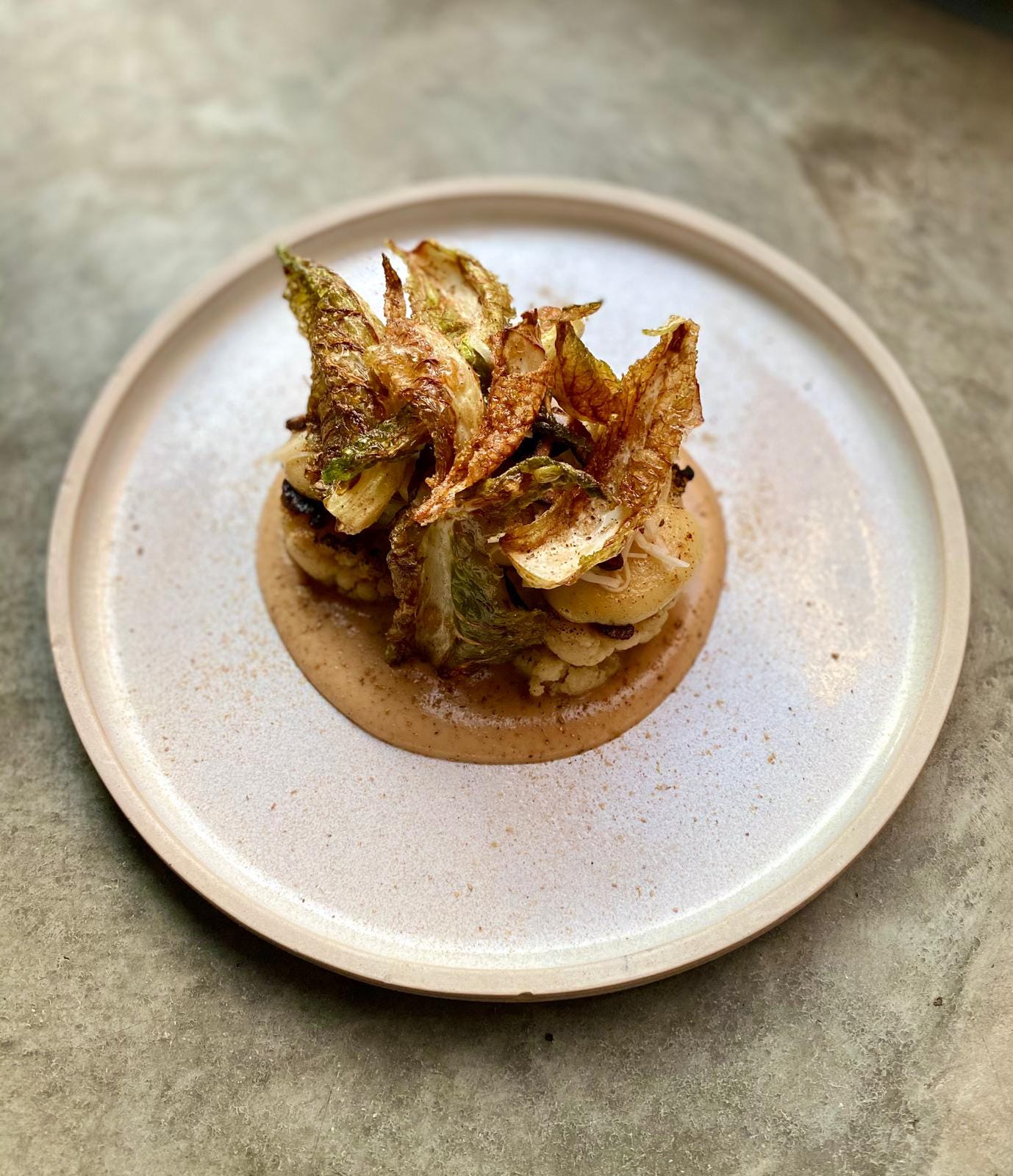
I have vague memories of witnessing Tom Kerridge use an entire cauliflower - the florets and stalk making a couscous, the leaves chopped up to make a slaw. I remember Jamie (Oliver - obviously) getting us all to eat our broccoli stalks, and learning that the stems of the herbs have way more flavour (anyone else heard coriander stems referred to as Indian chives?). This sort of cooking just made sense to me.
That continued to be the case as I grew into my role as a chef. In fact, part of what made Will and I click and realise that we’d like to open a restaurant together is because we both got excited by the idea of making something out of nothing. At Dinner by Heston we’d see containers of scraps and get our heads together to make lunch or snacks for the chefs out of them. We used to save up halibut and cod’s heads (if only we knew how important cod’s heads would be to us in the future) and vac pack them up for our incredible Chinese pastry chef to make congee for the staff. It was fun! The idea that food is there to be eaten and sometimes just needs a little bit of left-field thinking to make it exciting and delicious. It got our creative juices flowing and planted a seed which Fallow would grow from.
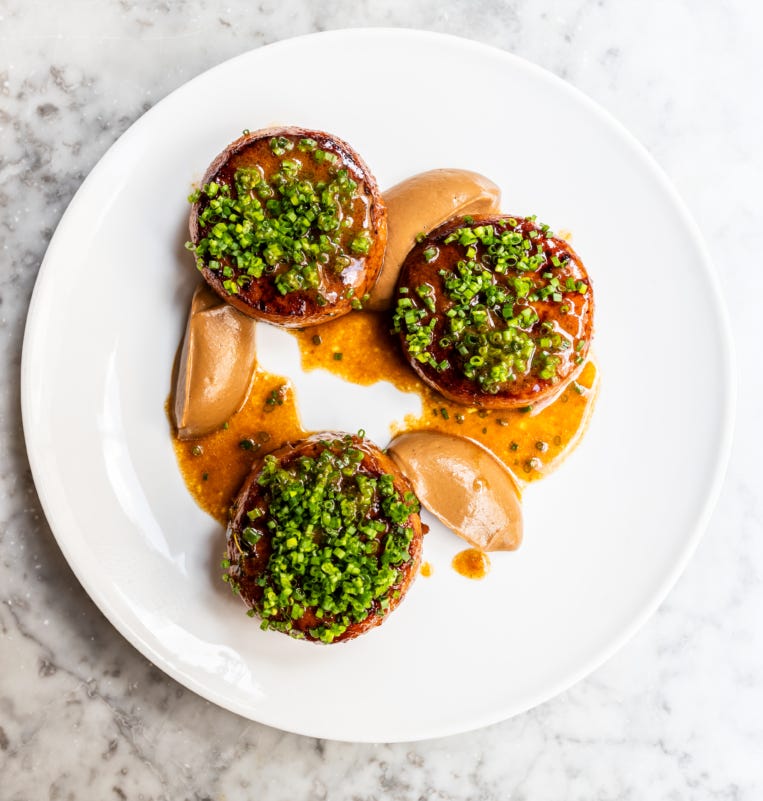
Around that time, Silo in Bristol was at the height of of its relevancy. We read his book (if you haven’t, you should) and got struck by the challenge: ‘waste is a failure of the imagination’. The concept of running a restaurant without a bin was completely mind boggling. Such a creative proposition, yes, but also so economically sensible. More than half of UK restaurants close within their first year. To see the amount of rubbish that leaves the premises and know that a high proportion of that is food that could have been transformed and plated up - well - we just couldn’t marry up the reality of a central London location without addressing that.
We knew that Henderson and chefs like him were already doing incredible things with meat, that Tom Brown and Josh Niland were ripping up the rule book with fish. For us, we were always inspired by what we could do with vegetables. Digging into the concept of ‘root to stem’ as a mirror for ‘nose to tail’. Challenging ourselves not to put cauliflower on the menu without having an idea for the leaves and taking inspiration from all those creative cooks before us.


So given that we’ve been talking about low waste cooking for, at least, the best part of 30 years, it’s interesting to me that Fallow’s approach caused so much of a splash. All of the economic constraints that hit professional kitchens are also felt at home, after all. Food costs more, energy bills are rising and poor Jamie is still out there trying his darnedest to get us to eat a bloody broccoli stalk. It seems like there remains this disconnect between home cooking and unfamiliar ingredients. Ultimately, though, this is about having a handful of very simple techniques up your sleeve to make every bit of your food taste incredible, and which just happen to make your budget stretch further in the meantime.
Let’s unpack the anatomy of a vegetable; I’ll show you how empty your food bin can be.

To cook pork belly and not consider the skin, fat and meat as separate entities that require different treatment would likely land you with at best juicy meat while the skin remained rubbery and the fat flabby and unrendered. With this approach you’d probably end up throwing them in the bin (the crackling! the potential!). In the same way, we need to familiarise ourselves with each element of the vegetable, viewing the tops, stalks, leaves, stems, seeds and even the peel as separate entities that are deserving of unique approaches.
The two vegetables that perhaps best demonstrate this? The leek and the cauliflower. I would hazard a guess, unsupported by data, that these are the vegetables with the biggest ratio of waste vs utilised flesh.
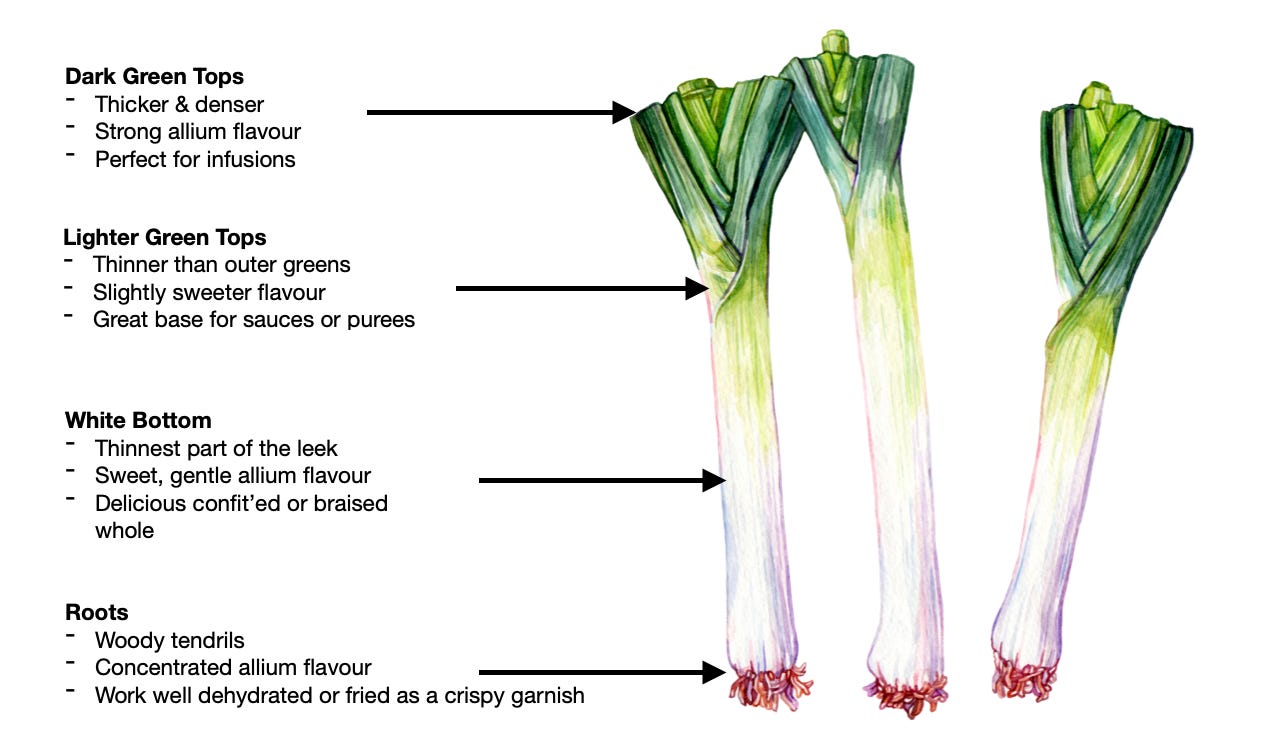
NB: Prep is important here. A common misconception is that to separate the dark green tops is to cut straight through from where the colour changes. In reality, the deeper the leek layer is, the less dark green there will be.
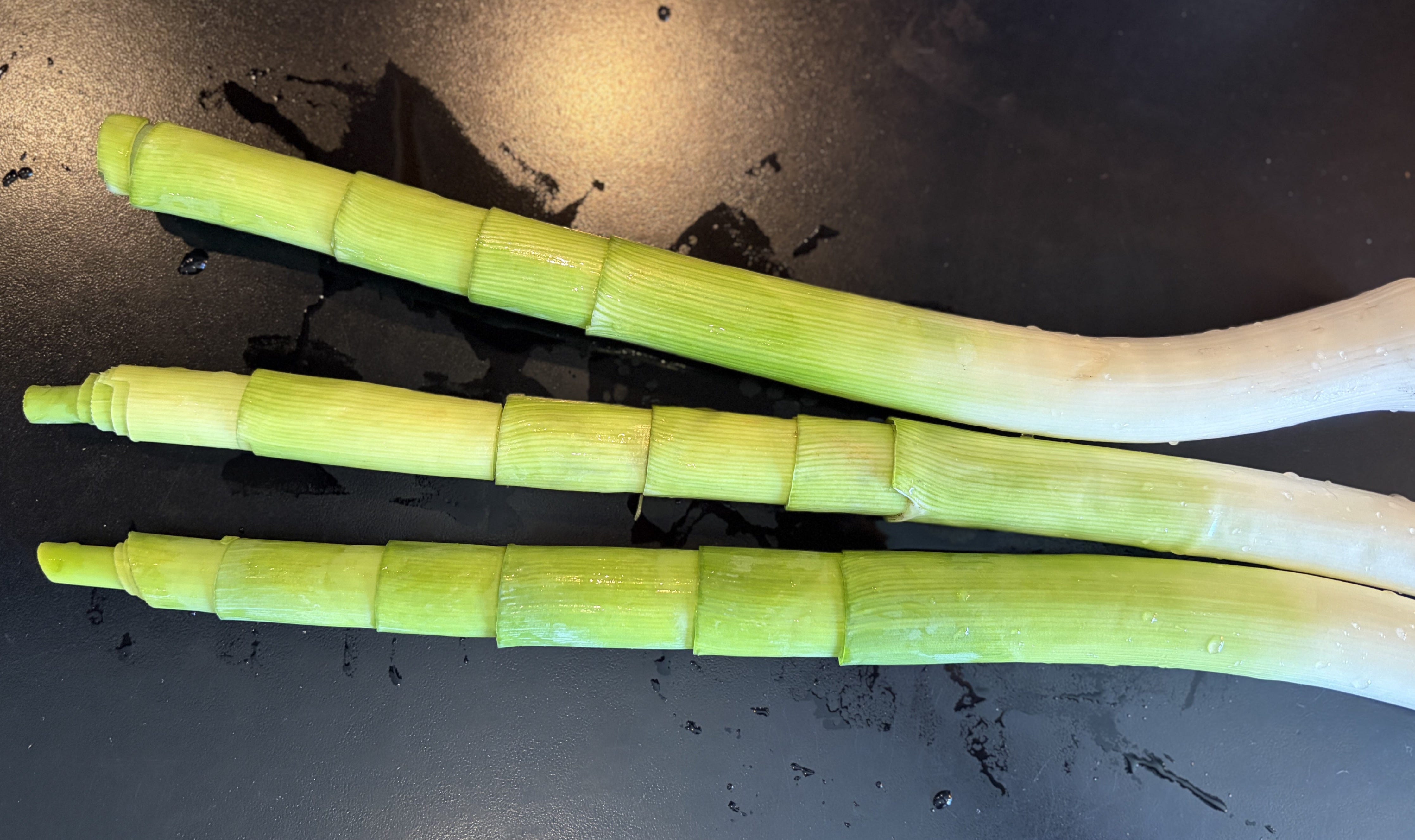
Gently run your knife around one layer at a time and you’ll end up with a a leek that looks a little like a leaning tower. Similarly, the roots themselves are not to be disregarded, but they do need to be washed well to get rid of any trapped soil.
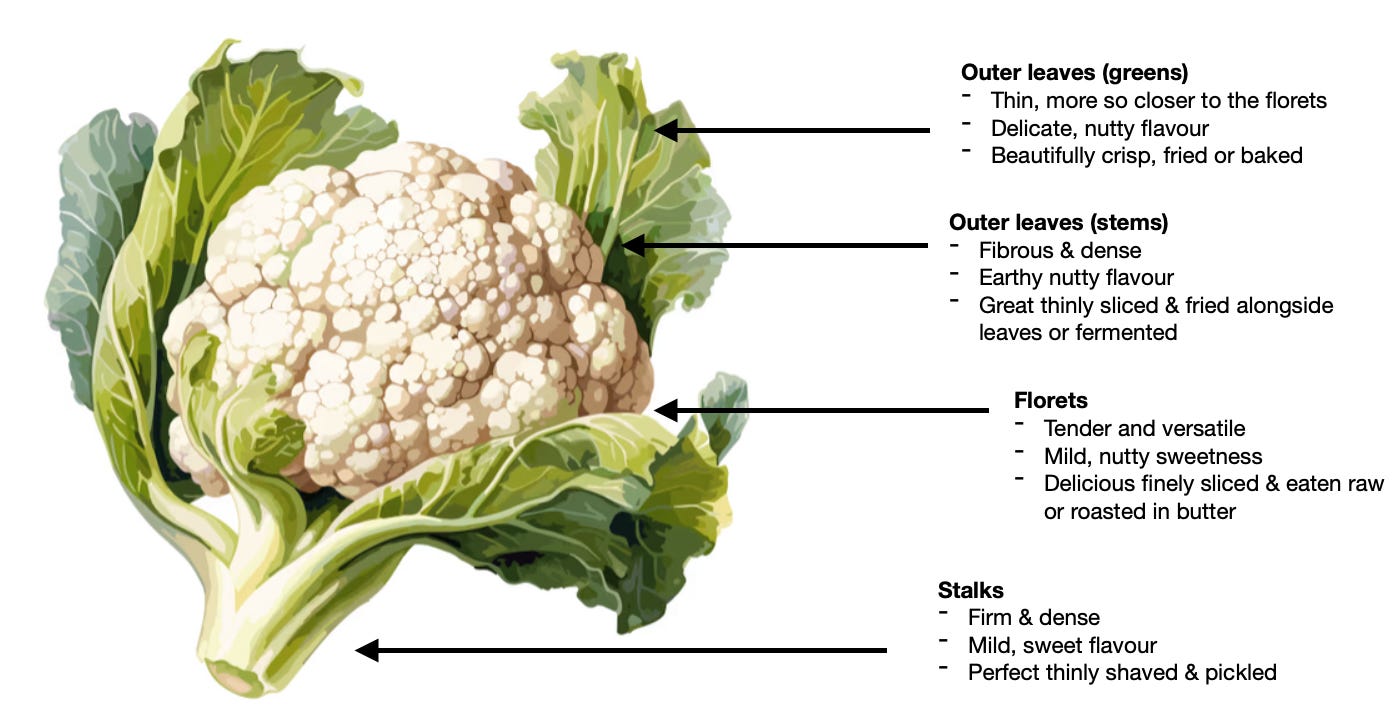
NB: Outer florets tend to have more compact and connected stem structures than the ones on the inside. If you are cooking something that relies on an intact floret, look here for your principal florets and use the more crumbly trim for sauces and purees.
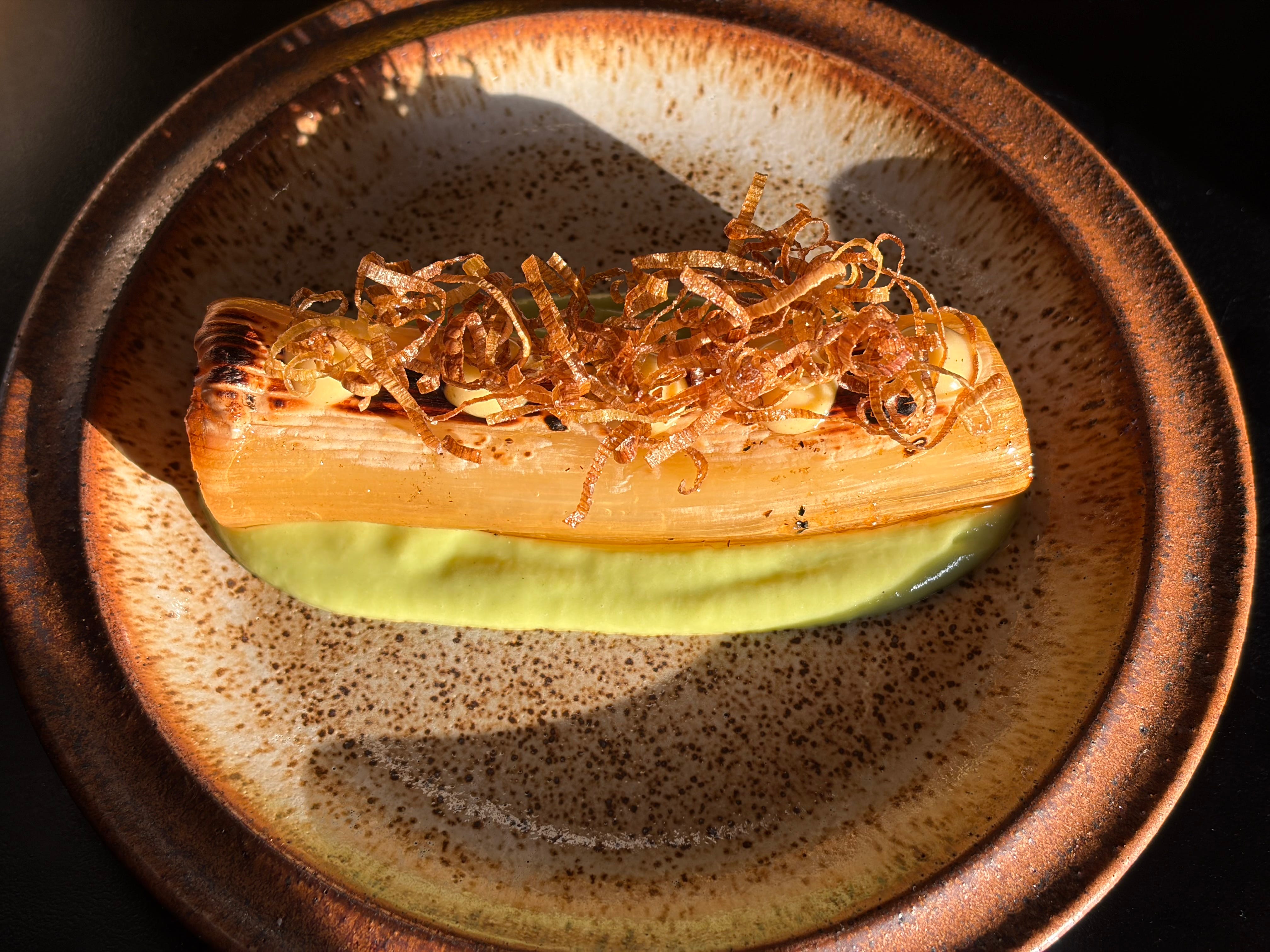
From using the whole vegetable, approaching it in this reverent way, some of my favourite recipes in Fallow have been birthed: from caramelised cauliflower on a cauliflower and whey puree, to fondant celeriac basted in celeriac stock, to confit smoky leeks set on leek and parmesan puree, garnished with smoky leek mayo and deep fried leek roots.
Dig a little deeper, consider every element of the food you buy, and you’ll find your creative cookery explodes.
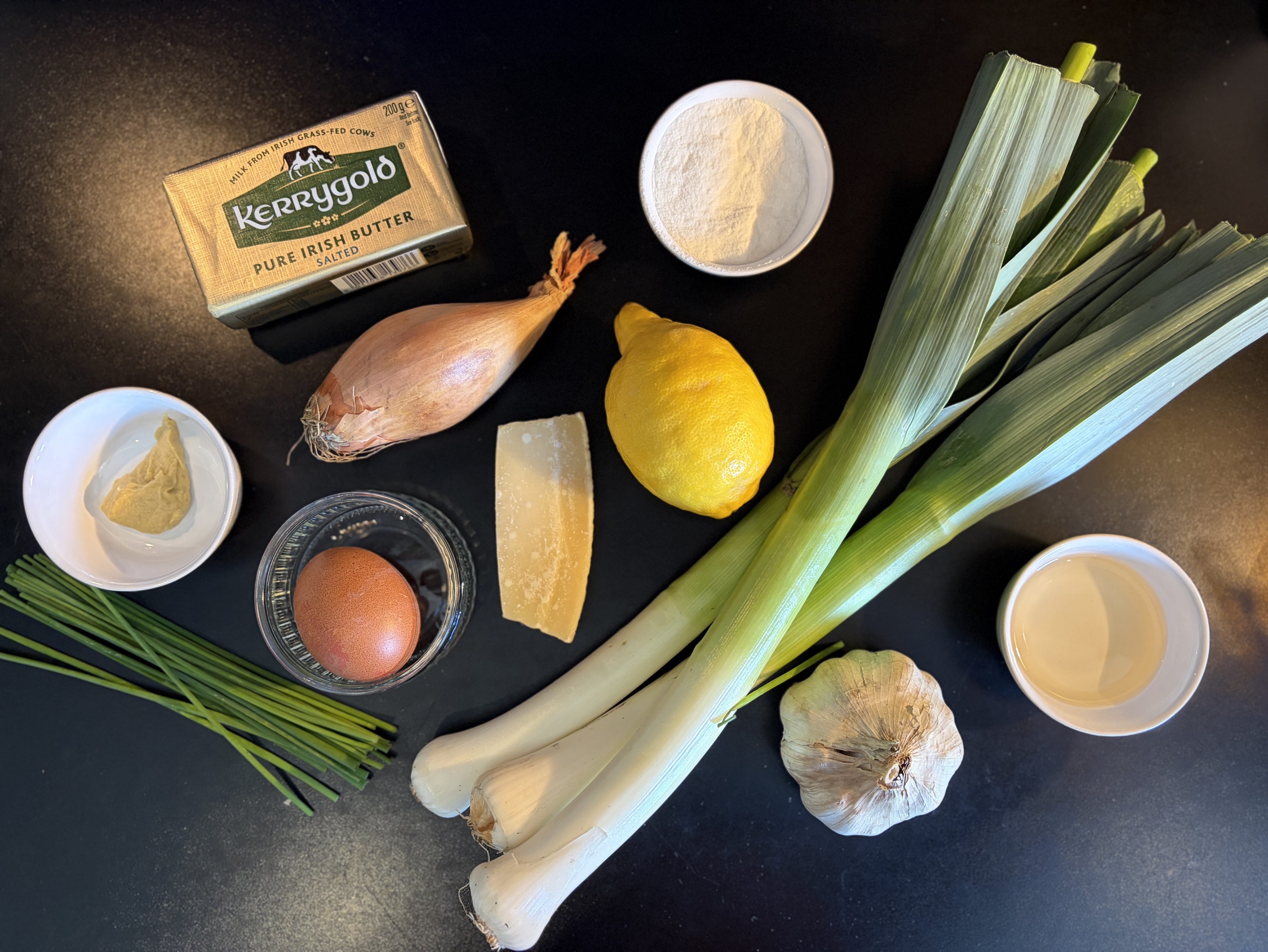

Serves 4 as a sharing starter
Equipment:
Heavy bottomed pan
Probe
Spider or heat proof slotted spoon
Ingredients:
2 or 3 leeks (depending on size)
Smoked leek oil:
Dark green leek tops (see above on preparation)
1/4 tsp salt
1 litre neutral oil
Smoky leek mayonnaise:
250ml Smoked leek oil (from above)
2 egg yolks
1 tbsp dijon mustard
1 tbsp white wine vinegar
1/2 tsp lemon juice (plus more to taste)
1/2 tsp fine sea salt (plus more to taste)
Leek and parmesan puree:
25g butter
Light green leek tops (see above on preparation), finely sliced (c. 225g)
1 shallot, finely chopped
2 cloves garlic, finely chopped
150ml whole milk (plus more as needed)
150ml veg stock
15g chives, roughly chopped
20g parmesan, grated
50ml double cream
Lemon juice, to taste
Fine sea salt, to taste
White pepper, to taste
Confit leeks:
750ml Smoked leek oil - or enough to submerge your leeks (from above)
2 x white middles
1/2 tsp fine sea salt
Black pepper
Crispy roots:
2 x Leek roots
50g Rice flour
Neutral oil - approx 500ml or enough to completely submerge your leeks
Fine sea salt, to taste
Method:
For the smoked leek oil. Take your leek tops (the dark green section) and very lightly coat in oil and a bit of fine salt.
Place your leek tops on the grill, over a gas flame or on a smoking hot pan (you can lay some foil down underneath the leeks to protect your hob/your pan), turning until they are incredibly well charred, approaching burnt.
When they are done, remove and roughly chop them up.
Place them in a container and add just enough oil to cover them (too much and the flavour will be diluted).
Store submerged in the oil for at least 24hrs. When you are ready to use, pass through a fine sieve and store.
For the smoky leek mayo. Place all your ingredients in a tall container (akin to a pint glass) and blitz with a hand blender till emulsified, starting from the bottom and working your way to the top of the mix. This will take about 10-15 seconds. Alternatively, if doing by hand, whisk together your egg yolk, vinegar, mustard, salt and lemon juice before very slowly trickling in your oil. Continue to whisk and trickle in your oil in a steady stream until it is all emulsified.
Taste and adjust salt and acidity as needed. Store in a sealed container in the fridge until needed.
For the leek and parmesan puree. Gently melt your butter in a pan over a medium heat. Once melted, add in your leeks and shallots and 1/2 tsp fine sea salt; stir regularly as they cook.
Once they begin to soften (about 4minutes), add in your garlic and continue to cook, stirring so that nothing catches or colours. Cook for another 2 minutes.
Add in your veg stock and milk, bring to a gentle simmer, and then cook with a lid on (or a cartouche) for another 5-10mins or until everything is completely tender.
Turn off the heat, add your chives, parmesan and double cream. Tip everything out into a blender and blitz until completely smooth, adding milk as needed so that the mixture is free flowing. Once smooth, taste and adjust seasoning and acidity as required. Pass through a fine sieve for a restaurant level smooth puree. Set aside.
For the crispy roots. Remove the roots from the bottom of the leeks by cutting them off with scissors (easier than attacking them with a knife). Soak your prepared roots in water of 20 minutes to hydrate. Pat dry.
Set a heavy bottomed pan over a medium heat. Fill with oil, enough to be able to generously submerge your roots, and heat to 150°c.
Once the oil is at temperature, toss the roots in rice flour and fry till golden and crisp. This should only take a couple of minutes. Use a spider or slotted spoon to remove from the oil and onto a plate lined with kitchen paper to drain any excess oil. Season with fine sea salt. Set aside.
For the confit leeks. You should now be left with just the white bottom section of the leek.
Set your oven to 130°c.
Place the leeks in a single layer in a oven safe dish (snug is good, purely as you’ll need less oil), sprinkle with 1/2 tsp salt and generous freshly cracked black pepper and add enough of your smoky leek oil, just to submerge.
Cook for 2 1/2hrs or until completely tender when pierced with a knife.
To serve. Generously pour your puree onto the bottom of your serving dish. Gently place your leeks on top. Using a squeeze bottle if you have one (or a couple of teaspoons if not) dot your mayo on top of your leeks and cover with your crispy roots.

Don’t throw away the smoky oil that you’ve confited your leeks in it. It will be deliciously smokey and alliumy in flavour. Use it as a flavourful base to cook with or to repeat the process (either of mayo or of confiting - or both).
If your leek doesn’t come with any roots on (which was the case with mine), reserve a little of the top light green like, finely slice it lengthways and fry that instead.
If your mayo splits, don’t panic. Start with another egg yolk and drizzle in your split mix (very slowly - as though it were your oil) as you whisk.
Thanks for reading!

‘I’m on a new supplement routine. The hero of it is Lionsmane extract. Feels like the mushroom parfait legacy is following me everywhere I go…’ - Jack
Next week, we’ll be tackling the godfather of the Fallow menu - the smoky beef rib.
See you there,
Jack & Will
youtube: @fallowchefs
instagram: @fallowchefs
tiktok: @fallowchefs
Wow, thank you for this information. I've read so much about not wasting food in the kitchen, but you have shown me HOW to avoid waste. Brilliant.❤️
The council's compost heap will be all the poorer, but who cares - bloody love a leek.